Physics of a Space Elevator
The Physics of a Space Elevator:
Hanging a Ladder from the Sky
The idea of a space elevator feels like myth: a cable stretching from Earth’s equator into space, climbers ascending to orbit without rockets. Yet unlike warp drives or reactionless thrusters, the space elevator does not violate known physics. It is a problem of classical mechanics and materials science—brutal, but not forbidden.
In this essay, we unpack the physics that make a space elevator theoretically possible, the constraints that make it daunting, and the quantitative thresholds that determine whether it can exist at all.
1. The Core Principle: Centrifugal Balance
A space elevator works because of Earth’s rotation.
An object in circular motion experiences a required inward (centripetal) acceleration:
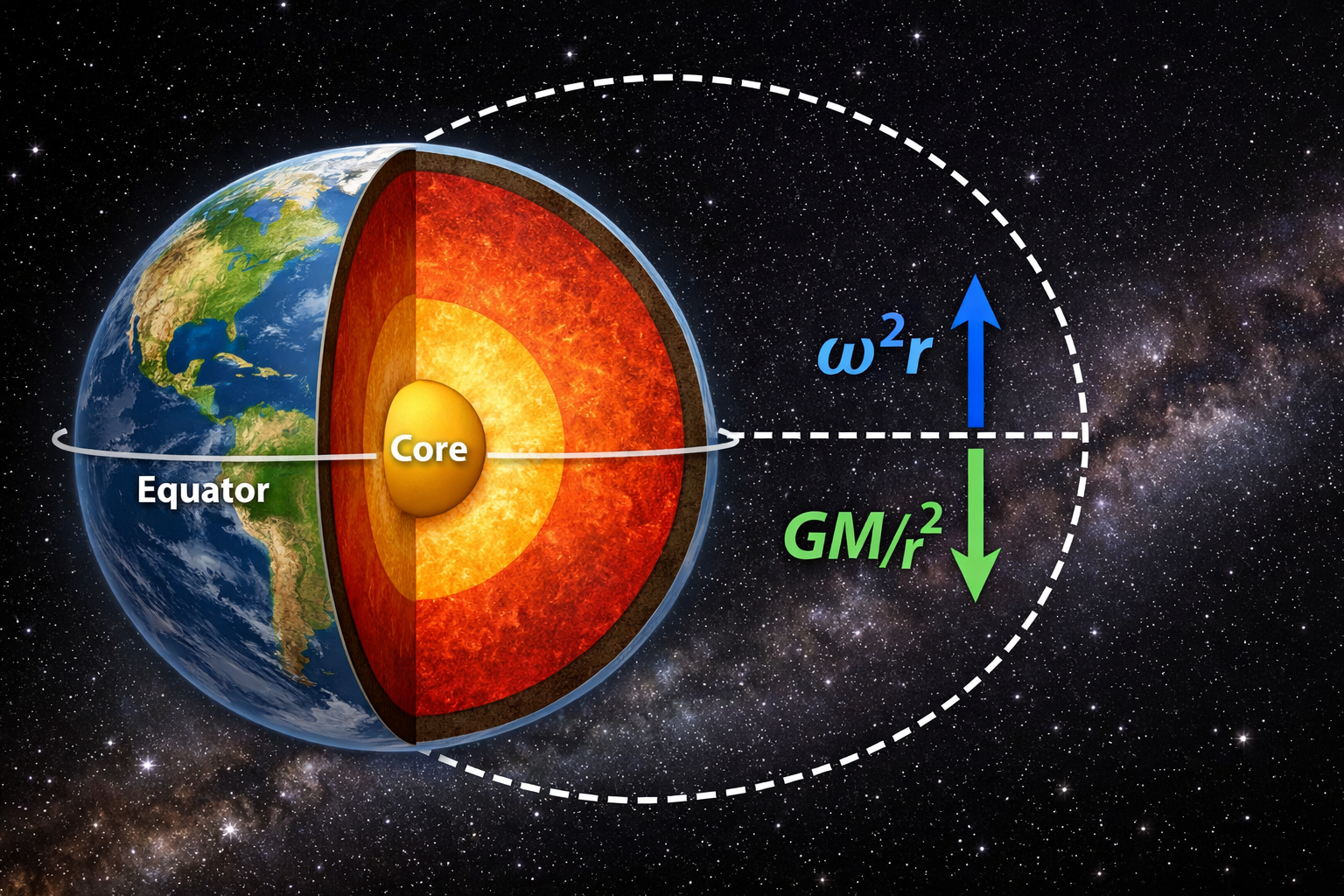
centripetal acceleration = ω²r
where: - ω is Earth’s angular rotation rate (~7.292 × 10⁻⁵ rad/s) - r is distance from Earth’s center
At geostationary orbit, the outward centrifugal effect in the rotating frame balances Earth’s gravitational pull.
At this altitude: - Orbital period = 24 hours
- Radius from Earth’s center ≈ 42,164 km
- Altitude above surface ≈ 35,786 km
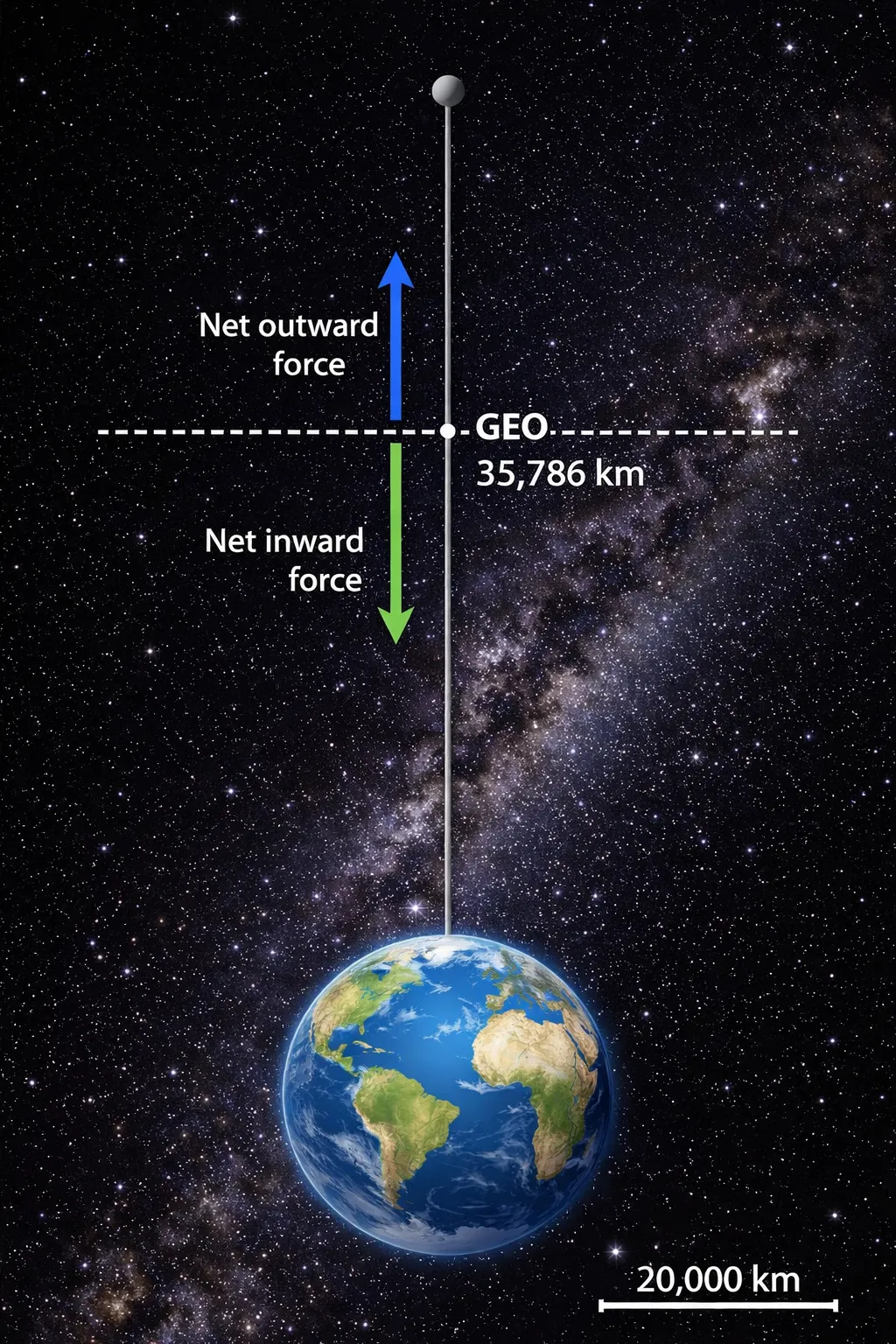
Key insight: - Below geostationary orbit → gravity dominates → net inward pull. - Above geostationary orbit → centrifugal effect dominates → net outward pull.
If a cable is attached to Earth at the equator and extended beyond geostationary orbit, the outward pull on the upper portion keeps the entire cable under tension.
The elevator does not stand on the ground. It hangs from space.
Figure 1. Force Balance at Geostationary Orbit.
2. Why the Cable Must Extend Beyond GEO
If the cable ended exactly at geostationary orbit, the tension at that point would be zero and the structure would collapse.
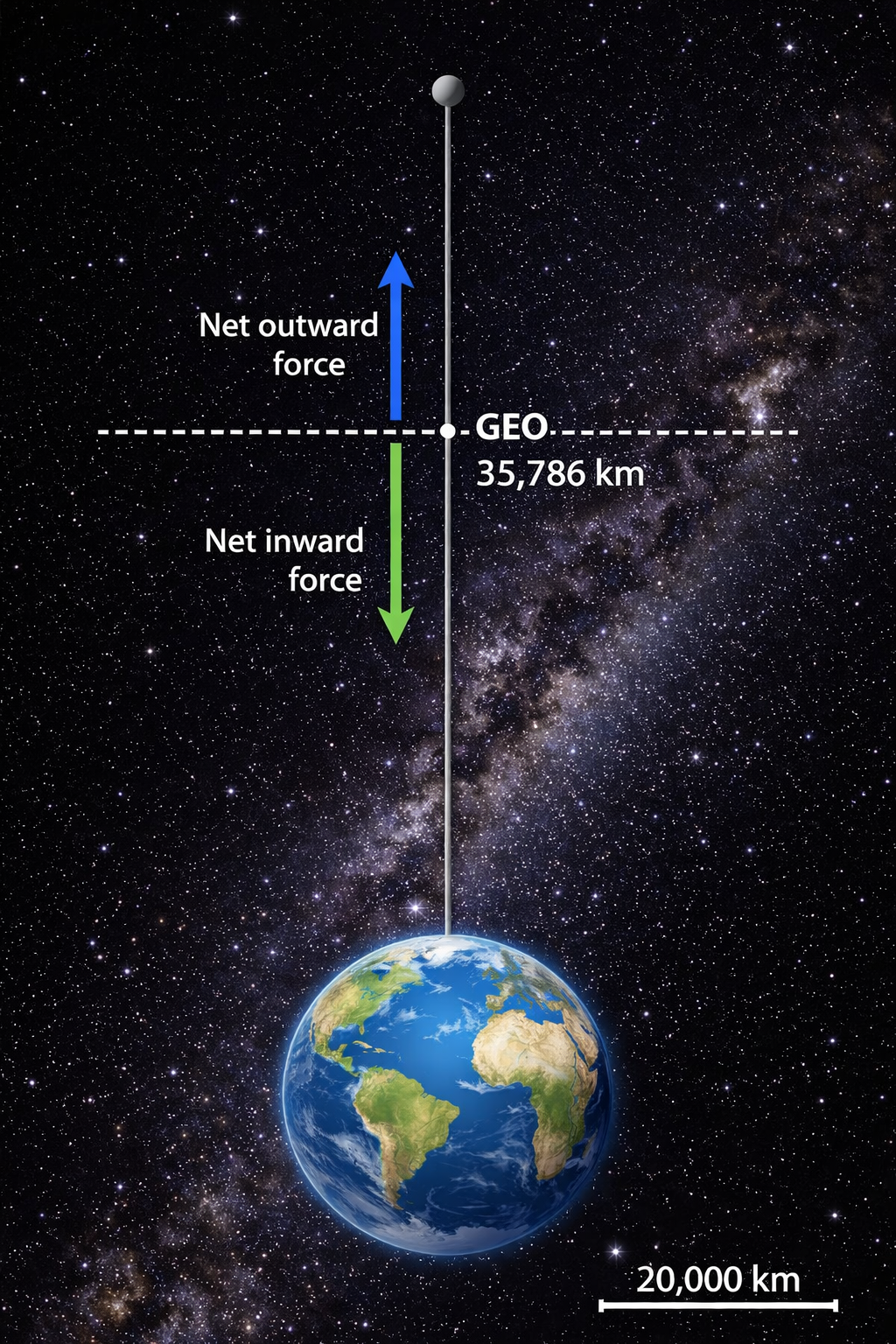
Instead, the cable must extend tens of thousands of kilometers beyond GEO, terminating in a counterweight. This upper mass experiences net outward acceleration, keeping the cable taut.
Typical design concepts extend to ~100,000 km from Earth’s center.
Figure 2. Full Space Elevator Geometry.
3. Tension Distribution Along the Cable
At any point along the cable, tension must support: - The weight of all cable below it - The changing balance between gravity and centrifugal acceleration
The effective acceleration at radius r is:
effective acceleration(r) = ω²r − GM/r²
Where: - G is the gravitational constant - M is Earth’s mass
At GEO, effective acceleration(r) = 0.
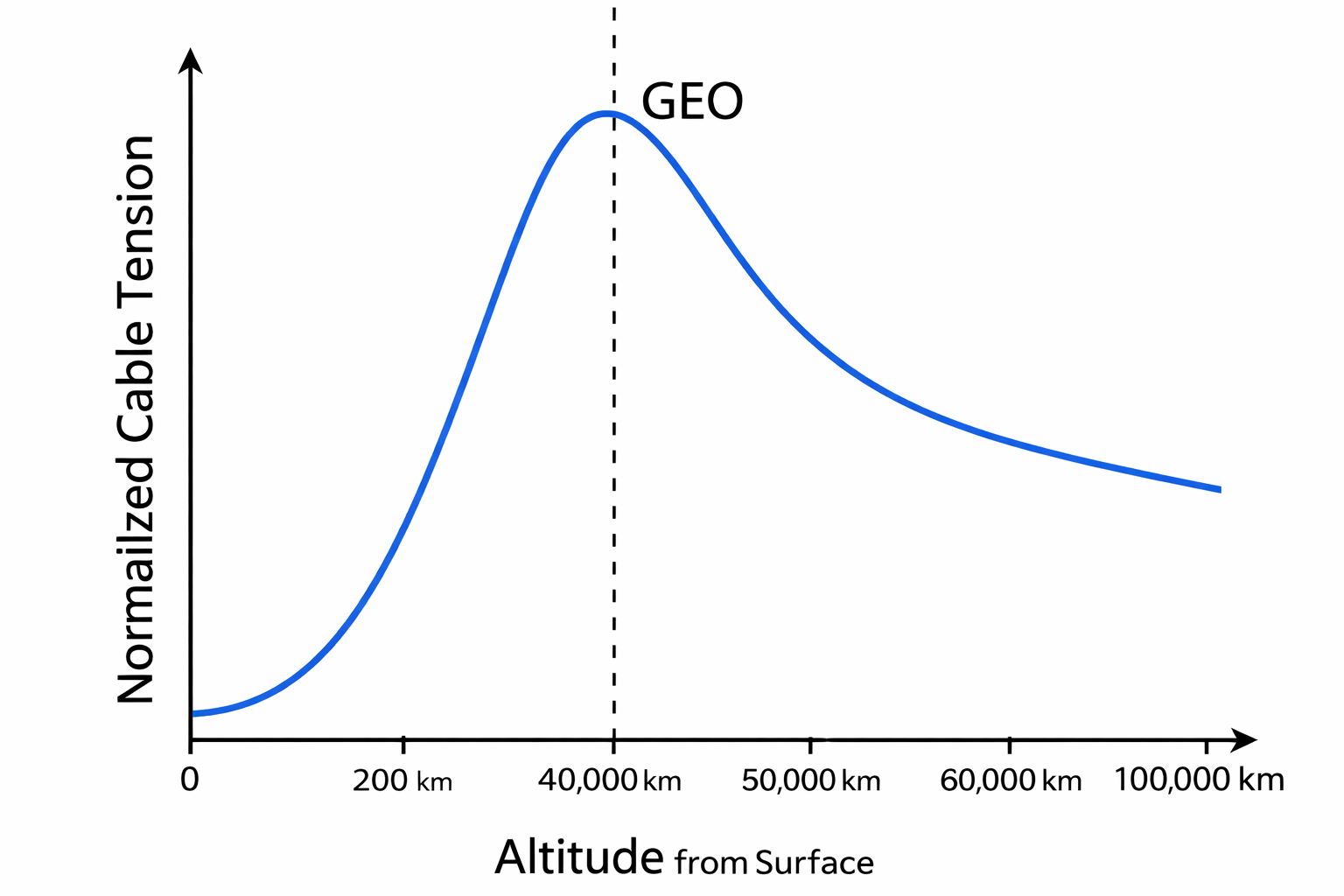
The maximum tension does not occur at the surface. It occurs near geostationary orbit.
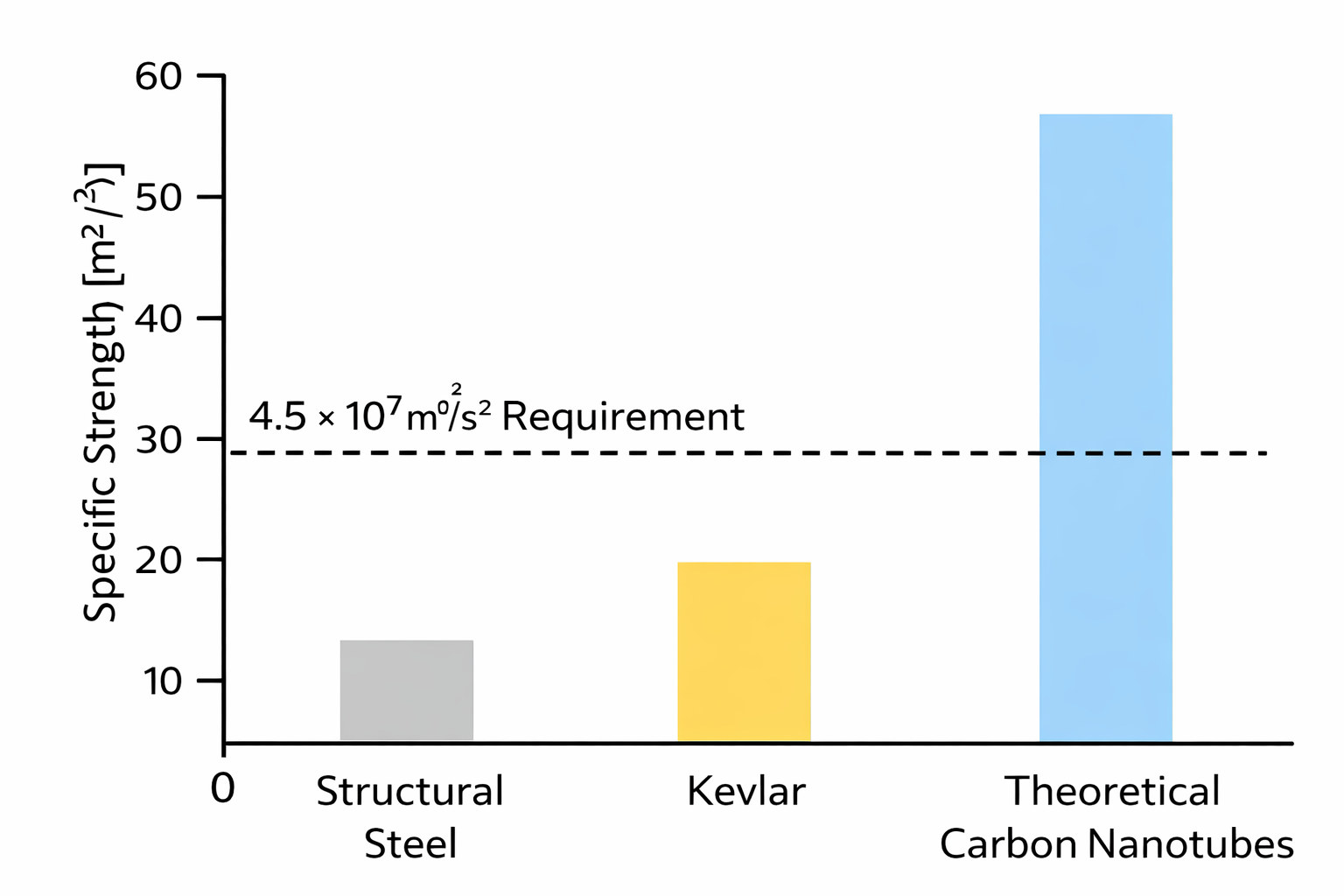
For Earth, the peak stress requirement corresponds to a required material-specific strength (strength-to-density ratio) of roughly:
σ/ρ ≳ 4.5 × 10⁷ m²/s²
This is the true engineering barrier.
Figure 3. Tension vs. Altitude Profile.
4. Materials: The Real Bottleneck
Steel is insufficient.
Kevlar is insufficient.
The required material must combine: - Extremely high tensile strength - Very low density
Theoretical candidates include: - Carbon nanotubes
- Graphene ribbons
These materials, in laboratory-scale form, exceed the required specific strength.
The challenge is manufacturing tens of thousands of kilometers of defect-free material. A single critical defect could cause catastrophic failure.
The problem is not theoretical strength. It is planetary-scale materials engineering.
Figure 4. Specific Strength Comparison.
5. Energy Advantage Over Rockets
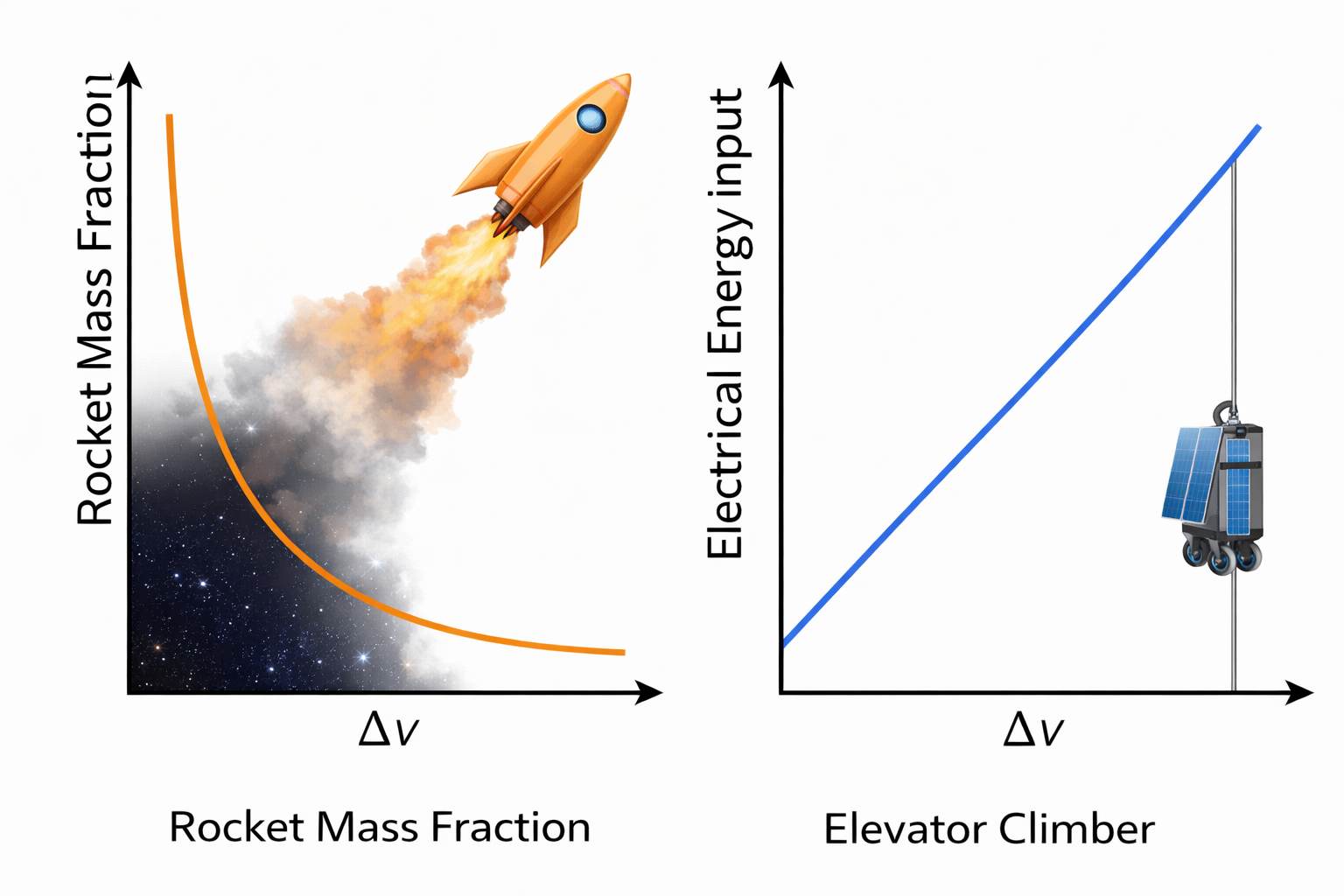
To reach orbit requires ~9.4 km/s of delta-v. Chemical rockets obey the rocket equation:
Δv = exhaust velocity*ln(initial total mass/final dry mass)
A space elevator bypasses this entirely. A climber gains gravitational potential energy electrically.
Energy to lift 1 kg to GEO (order-of-magnitude estimate):
E ≈ mgh ≈ (1 kg)(9.8 m/s²)(3.6 × 10⁷ m) ≈ 3.5 × 10⁸ J
Approximately 350 MJ per kilogram.
Large—but manageable compared to rocket propellant mass ratios.
Electric climbers powered by ground-based lasers or onboard nuclear systems become plausible.
Figure 5. Energy Architecture Comparison.
6. Dynamic Stability and Oscillations
A 100,000 km cable is not static.
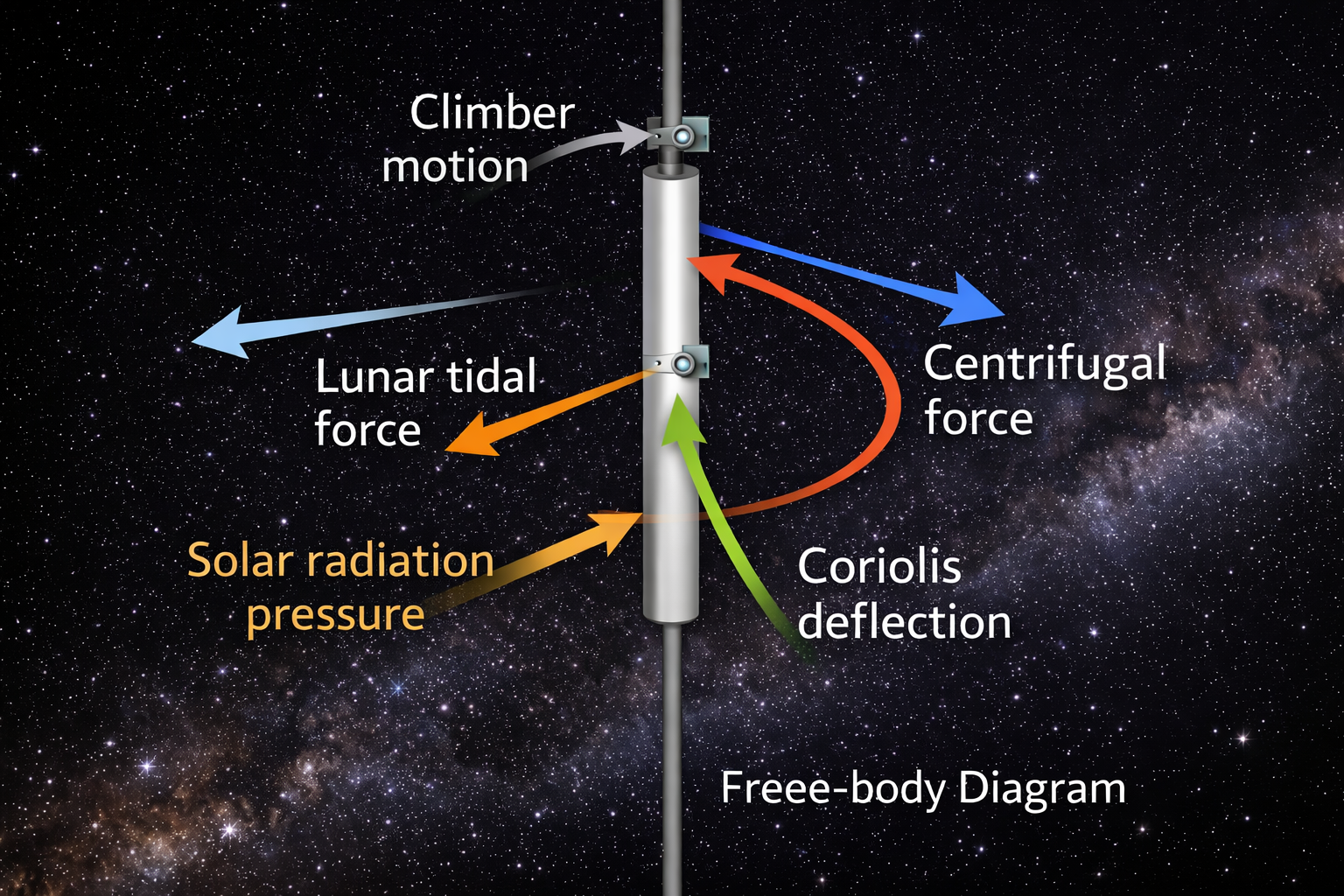
It must survive: - Atmospheric drag (lower sections) - Coriolis forces from climbing payloads - Tidal forces from the Moon - Solar radiation pressure - Micrometeoroid impacts
The system behaves like a driven nonlinear oscillator with enormous lever arms.
Active stabilization would be mandatory, potentially involving: - Movable counterweights - Mass redistribution along the tether - Electrodynamic damping systems
Figure 6. Dynamic Forces on the Tether.
7. Planetary Suitability
Earth is challenging because of: - Strong gravity - Fast rotation - Atmospheric weather and lightning
Mars reduces material strength requirements but lacks sufficient rotational speed for a classical geostationary design.
The Moon is far more favorable. A lunar elevator extending toward the Earth–Moon L1 point would require far weaker materials than Earth’s version.
8. Failure Modes
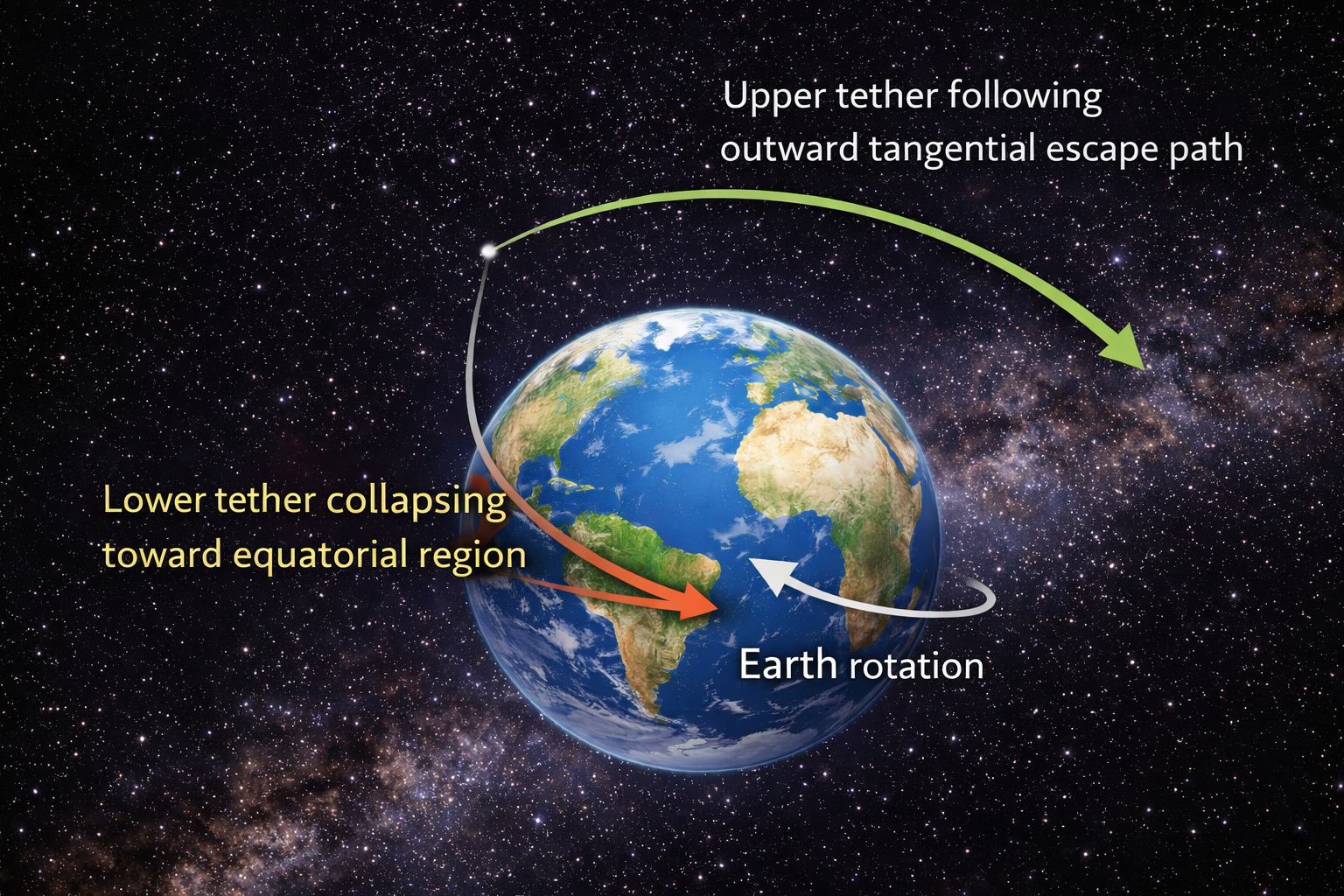
If the cable snapped: - The lower portion would fall mostly near the equator. - The upper portion would fly outward into space.
Orbital mechanics prevent a planet-encircling whip scenario, but debris risks would be severe.
Figure 7. Failure Dynamics Scenario.
9. Is It Physically Possible?
Physics verdict: Yes.
No conservation laws are violated. No exotic matter required.
Engineering verdict: Not yet.
We may be one or two materials revolutions away from feasibility.
Conclusion
A space elevator sits on the boundary between conceivable and unattainable. It is a megastructure built not with speculative physics, but with tensile strength and angular velocity.
If humanity builds one, it will mark the transition from chemical propulsion to orbital infrastructure civilization. It would not merely lower launch costs.
It would redefine what “planetary surface” means.
References
Pearson, J. (1975). The Orbital Tower: A Spacecraft Launcher Using the Earth’s Rotational Energy. Acta Astronautica.
Edwards, B. C. (2000). The Space Elevator: NIAC Phase II Final Report. NASA Institute for Advanced Concepts.
Aravind, P. K. (2007). The Physics of the Space Elevator. American Journal of Physics.
NASA Institute for Advanced Concepts archival studies on tether systems.

